You lie down on a wide massage bed, wearing loose trousers and a t-shirt. No oil, nothing to take off. And then the therapist starts folding you slowly into positions you would never reach on your own. A palm leans into your back, a leg is drawn out long, your whole body is gently rocked. Is this still a massage? Or is it stretching that someone else does for you?
That is exactly the question almost everyone asks the first time they try Thai massage. And the answer is: it’s both. Thai massage doesn’t knead the muscles the way you know from a classic “Swedish” massage. It blends pressure, stretching and a calm rhythm into a treatment the Thais fondly call “lazy yoga”. You simply lie there and rest while the therapist does all the work. Let’s walk through what Thai massage really is, where it came from, how it feels and who it suits. And who it doesn’t.
Quick answer
Thai massage is an ancient technique from traditional Thai medicine. It combines acupressure (rhythmic pressure with the palms, thumbs, elbows and feet) with passive stretching along traditional lines called “sen”.
It is traditionally performed on a mat (with us on a wide massage bed), over loose clothing and most often without oil. It brings deep release, greater flexibility and a quieter mind. It is care and relaxation, not a medical treatment.
In this article
Not quite the massage you know
Most of the massages we know in the West are built on oil and kneading. Thai massage goes about it differently. It comes from traditional Thai medicine and the old idea that a network of invisible lines called “sen” runs through the body. The work focuses mainly on ten principal ones (sip sen). Think of it as a ritual map rather than medical anatomy, a framework the therapists have used to guide their hands for centuries. And whether or not you believe in energy lines, you feel the result in the most tangible way: released muscles and a lighter body.
So what sets Thai massage apart from the one you’re used to?
- Pressure and stretch in one. It isn’t just working over your back. The therapist guides you into yoga-like poses that loosen the joints and spine on their own, while applying deep, rhythmic pressure along the lines.
- You stay dressed and passive. In the traditional version you don’t undress and you don’t have to do a thing. Your only job is to breathe and let yourself be led.
- The therapist’s whole body works. Not just fingers, but palms, thumbs, forearms, elbows, knees and feet. That’s how they reach a depth of pressure hands alone couldn’t manage.
If you’re weighing it up against a classic oil massage, you’ll find the comparison in Thai vs classic massage.

Where it comes from: 2,500 years and one temple
Thai massage is remarkably old. Its roots reach back roughly 2,500 years, and not to Thailand but to India. Its founder is traditionally held to be the physician Jivaka Kumar Bhaccha (revered in Thailand as Shivago Komarpaj), a contemporary of the Buddha and personal doctor to the monastic community. It was shaped into its present form by Ayurveda, the yogic tradition and elements of traditional Chinese medicine. So it’s a merging of several old schools rather than a single invention.
The method reached Thailand together with Buddhism and was passed down for centuries orally in the temples, from teacher to student. The best-known centre of teaching became Wat Pho temple in Bangkok, where the techniques are carved into stone tablets to this day. That temple origin also explains why a classic Thai massage is traditionally done on a mat on the floor rather than on a bed. Originally a healing and spiritual practice, it is valued today mainly as a way to relax and recover. In 2019 UNESCO added it to the list of intangible cultural heritage. If you like the wider context, you’ll find it in our article on the history of massage.
How it works, and how it actually feels
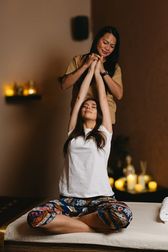
Traditionally a Thai massage takes place on a mat on the floor; with us, on a wide massage bed. You wear loose clothing, which we can lend you if needed. The therapist usually works from the feet upwards, flowing between four core techniques:
- Acupressure: slow, building pressure with the palms, thumbs, elbows and feet along the lines.
- Passive stretching: yoga positions the therapist gently guides you into and that you couldn’t reach on your own.
- Joint mobilisation: gentle movement of the hips, shoulders and spine for a greater range of motion.
- Rhythmic rocking: cradling movements after which the muscles “switch off” and the nervous system settles.
How will you experience it? It isn’t a quiet, sleepy treatment like an oil relaxation. It’s active and rhythmic, at times surprisingly intense, but it should never hurt. The next day you may feel mild muscle tenderness, much like after exercise. That’s perfectly fine. For a first visit we recommend 90 minutes. Sixty minutes covers the whole body at a calm pace; ninety also leaves time for the stiff spots. Step by step, from arrival to the closing cup of tea, we describe it in how a Thai massage works.
What Thai massage gives you
Thai massage is loved because it works on body and mind at once. It’s not about miracles or cures: it’s about deep release and wellbeing, which clients most often describe like this:
- Release of muscle tension: deep pressure dissolves the stiffness that builds up in muscles and connective tissue at a desk all day.
- Greater flexibility and range of motion: passive stretching “opens” the hips, shoulders and spine, often more than your usual workout does.
- Better circulation: alternating pressure and release gets the blood moving into warmed muscles.
- Calm and less stress: the slow rhythm shifts the body out of alert mode into rest; many leave as settled as after a good night’s sleep.
- A feeling of “reset” and better sleep: the mix of stretching and calm often makes for an easier drift-off in the evening.
- Relief for the back and neck: especially welcome with the stiffness of sedentary work.
What a massage can genuinely do, and where its limits lie, we lay out honestly in the effects of Thai massage. Bothered by one stiff spot in particular? Read about massage for back pain, for example.
Dry or oil? The little family of Thai massages
A whole family of treatments hides under one name. The basic signpost is simple. It comes down to whether you want more stretching or more gliding:
- Traditional Thai Massage: traditional and “dry”: no oil, over clothing. The most stretching and pressure; ideal when you’re stiff and want a proper loosening up.
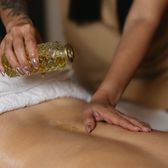
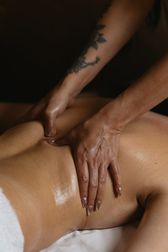
- Thai Oil Massage: gentler, with natural oil; more gliding and release, less acrobatics. The choice for pure relaxation.
- Aromatherapy Massage: an oil massage with essential oils of your choice and mood.
- Thai Herbal Compress Massage: warming with hot aromatic poultices, for when the cold reaches your bones.
- Tranquility Ritual: our own blend of massage, skincare and aromatherapy.
Not sure where to start? Our overview of the types of massage, our short which massage is right for me guide, or our full price list will help.
Who it suits, and when to think twice
Thai massage suits practically anyone who feels stiff from long hours of sitting, stress or sport and wants real release. It’s a great fit for those who don’t want to just lie there passively and will appreciate an active full-body stretch. For a lasting effect, once a week to once a fortnight is usually ideal, but even one massage a month keeps the muscles supple and stress in check. More on the rhythm in how often to have a Thai massage.
There are, however, times when it’s wise to postpone a massage or check with a doctor first.
- During pregnancy we don’t recommend a traditional Thai massage. For mums-to-be we offer a gentle pregnancy massage.
- Be cautious too with acute inflammation, fever, fresh injuries or vascular conditions. In those cases the body needs rest and a doctor, not a massage.
- You’ll find a complete overview in the article on massage contraindications. And if you’re unsure, get in touch beforehand, we’re happy to advise.
Key takeaways
- Pressure and stretch in one. Thai massage blends acupressure with passive stretching along the traditional “sen” lines.
- “Lazy yoga.” You stay dressed and passive while the therapist does all the work, usually without oil.
- Ancient origin. Its roots reach 2,500 years back to India; Wat Pho temple shaped today’s form, and since 2019 it’s on the UNESCO list.
- What it gives. Released tension, greater flexibility, better circulation and a calmer mind, not a cure.
- You set the pressure. Ask for gentler or firmer at any time; it shouldn’t hurt.
- When to be cautious. Pregnancy, acute inflammation, fever, injuries or vascular issues call for a doctor first.
Traditional Thai massage, a few steps from Old Town Square
Our certified therapists come from Southeast Asia and trained at renowned schools there. After the massage, warm tea is waiting.
Free cancellation up to 24 h aheadpay at the salon
About the Traditional Thai Massage